
Parotid Cancer Treatment in Pune
If you or a loved one has been diagnosed with a parotid tumour or is searching for a trusted parotid cancer specialist in Pune, Dr. Chirag Bhirud provides advanced salivary gland cancer treatment in Pune with a patient-first approach. He is an MCh-qualified Surgical Oncologist with 11+ years of experience and over 500 head and neck surgeries performed at Jupiter Hospital, Baner, Pune. Dr. Chirag Bhirud also consults at Cancer Care Clinic, Pimple Saudagar, Pimpri-Chinchwad, making expert parotid cancer care accessible across Pune and PCMC.
As a Cancer Specialist in head and neck cancer surgery, Dr. Chirag Bhirud performs superficial parotidectomy, total parotidectomy, and facial nerve-sparing parotid gland surgery in Pune — tailoring each approach to the type, grade, and stage of the tumour. Whether your parotid tumour is benign or malignant, early consultation with an experienced parotid tumour surgeon in Pune leads to better surgical outcomes and a higher chance of preserving facial nerve function.
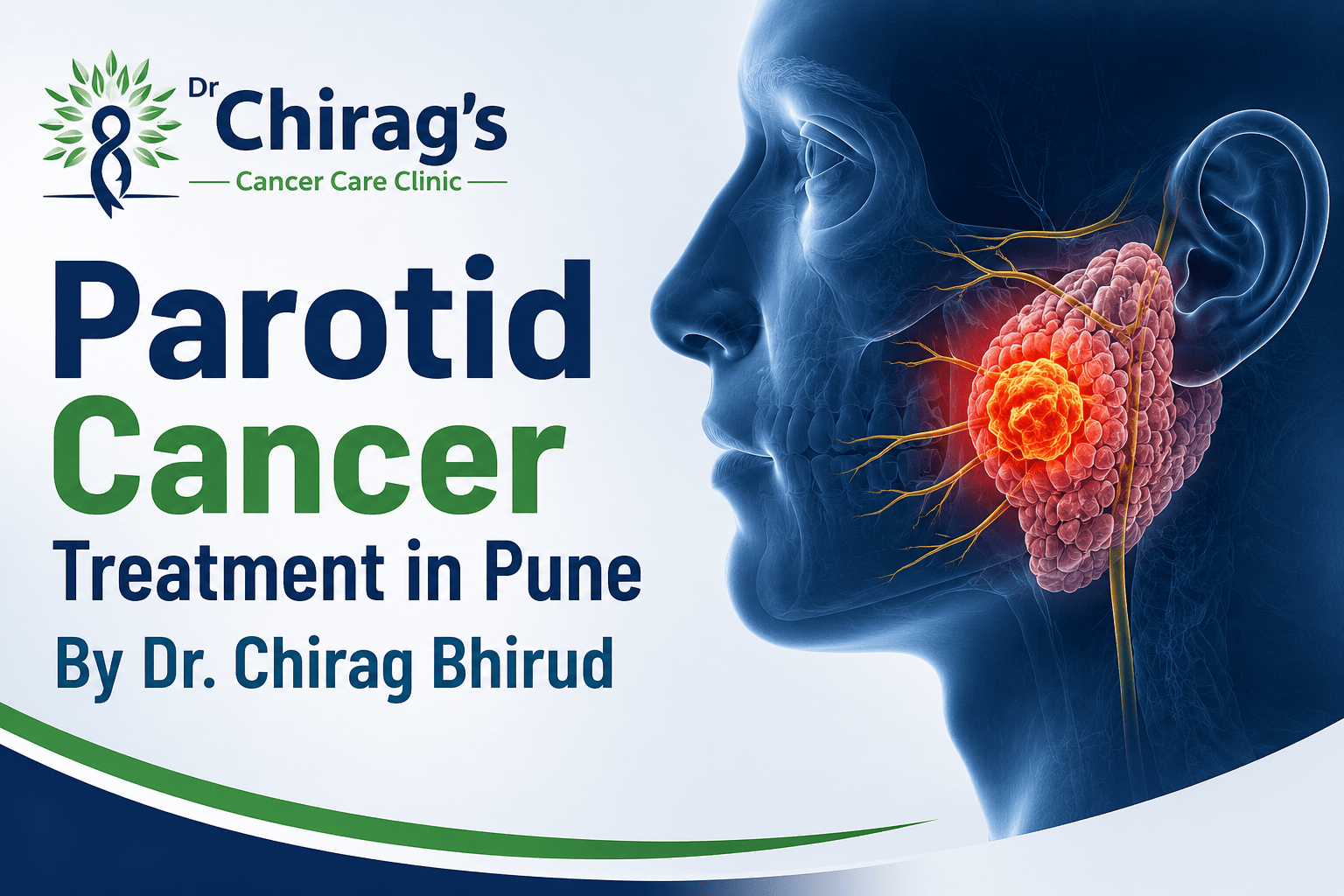
What is Parotid Cancer?
Parotid cancer is a rare type of cancer that develops in the parotid gland, the largest of the salivary glands located just in front of the ear. It can cause a painless lump near the jaw or ear, facial weakness, or difficulty swallowing in some patients. Although it is different from Mouth Cancer, both are head and neck cancers that require early diagnosis and specialised treatment. Timely medical care can improve treatment outcomes and help preserve facial nerve function.
Types of Parotid Cancer
Not all parotid tumours are the same. Understanding the type is essential because each behaves differently and requires a different surgical and therapeutic approach. Dr. Chirag Bhirud evaluates the exact tumour type before planning any treatment.
- Mucoepidermoid Carcinoma — the most common malignant parotid tumour; classified as low-grade, intermediate-grade, or high-grade; low-grade tumours carry an excellent prognosis after surgery while high-grade tumours are more aggressive and require combined surgery and radiation; this is the type most often targeted in mucoepidermoid carcinoma treatment in Pune
- Adenoid Cystic Carcinoma — the second most common type; known for slow growth but a strong tendency to spread along nerves (perineural invasion), making complete surgical removal critical; recurrence can occur years after initial treatment, requiring long-term follow-up
- Acinic Cell Carcinoma — a low-grade cancer generally associated with a good prognosis; occurs most often in the parotid gland; treated primarily with surgery
- Squamous Cell Carcinoma of the Parotid — a high-grade, aggressive cancer often associated with prior radiation to the head and neck; requires radical surgery and post-operative radiation
- Malignant Mixed Tumour (Carcinoma ex Pleomorphic Adenoma) — arises from a pre-existing benign pleomorphic adenoma; can be locally invasive; emphasises why all parotid lumps — even painless ones — should be evaluated promptly
- Lymphoma of the Parotid — a rare type; managed differently from epithelial parotid cancers; requires haematology involvement alongside surgical oncology
Stages of Parotid Cancer
Parotid cancer is staged using the TNM system — Tumour size (T), lymph Node involvement (N), and Metastasis (M). Staging determines how far the cancer has spread and directly guides the treatment plan.
- Stage I — tumour is ≤2 cm and confined to the parotid gland with no lymph node involvement or facial nerve involvement; treated with superficial or total parotidectomy with nerve preservation; excellent chance of cure
- Stage II — tumour is 2–4 cm, still limited to the gland with no nodal or nerve involvement; surgery remains the primary treatment, often followed by radiation in selected cases
- Stage III — tumour is larger than 4 cm or has spread to a single nearby lymph node; or there is minimal extraparotid extension; surgery combined with post-operative radiation therapy is standard
- Stage IVA — tumour invades the skin, mandible, ear canal, or facial nerve; or has spread to multiple lymph nodes; requires radical surgery including possible facial nerve sacrifice with reconstruction, followed by chemoradiation
- Stage IVB — tumour has invaded the skull base or carotid artery — technically unresectable in most cases; treatment is chemoradiation or palliative
- Stage IVC — cancer has spread to distant organs such as the lungs or liver; systemic therapy is the primary approach
Signs & Symptoms of Parotid Cancer:
Early identification is key when it comes to tackling parotid cancer. If you’re experiencing any of the symptoms below, consult a specialist immediately:
- Lumps or swelling near the ear, jaw, or neck
- Persistent pain in the neck, face, or area near the ear
- Changes in facial symmetry, such as muscle weakness or numbness
- Difficulty swallowing
- Unexplained drainage of fluid from your ear
- A noticeable change in saliva production
These symptoms can be caused by other conditions, so a professional diagnosis is crucial.
Causes & Risk Factors of Parotid Cancer:
Understanding the causes of parotid cancer is still an area of ongoing research. While specific causes remain unclear, several recognised risk factors could contribute to its development:
- Radiation exposure – Frequent exposure to radiation, either therapeutically or environmentally, increases the risk.
- Genetic predispositions – A family history of salivary gland cancer may heighten susceptibility.
- Viral infections – Certain viruses, such as Epstein-Barr and HIV, might play a role.
- Lifestyle factors – Tobacco use or occupational exposure to industrial substances like chemicals or asbestos may elevate risk.
While these factors can contribute to risk, it’s important to note that many individuals diagnosed with parotid cancer may not fit these criteria. This emphasises the importance of regular check-ups.
How is Parotid Cancer Diagnosed in Pune?
Accurate diagnosis is the foundation of effective parotid cancer treatment. Dr. Chirag Bhirud follows a structured diagnostic protocol at Jupiter Hospital, Baner — combining clinical examination, advanced imaging, and tissue biopsy to determine the exact nature, size, grade, and spread of the tumour before recommending any treatment.
Clinical Examination — Dr. Chirag Bhirud assesses the size, consistency, and mobility of the parotid lump; checks for facial nerve weakness or asymmetry; and evaluates neck lymph nodes for signs of spread; a firm, fixed lump with facial weakness is treated as malignant until proven otherwise
MRI — the preferred imaging tool for parotid tumours; provides detailed visualisation of soft tissue, deep lobe extension, and facial nerve involvement; essential for pre-surgical planning
CT Scan — assesses bone involvement of the mandible or skull base, lymph node status in the neck, and overall tumour spread
Ultrasound — a quick, non-invasive first-line investigation for any palpable parotid lump; used to guide needle biopsy in real time
PET-CT Scan — recommended in advanced or high-grade cases to detect distant metastasis before finalising the treatment plan
Fine Needle Aspiration Cytology (FNAC) — the standard biopsy technique; a thin needle collects cells from the parotid lump under ultrasound guidance to confirm whether the tumour is benign or malignant and identify the histological type
Core Needle Biopsy or Frozen Section — used when FNAC results are inconclusive; provides a definitive pathological diagnosis before or during surgery
Once the diagnosis is confirmed, Dr. Chirag Bhirud stages and grades the tumour using the TNM system to build a personalised, stage-specific treatment plan. As a specialist in salivary gland cancer treatment in Pune, Dr. Chirag Bhirud ensures no two patients are treated identically — every plan is guided by the exact type, grade, and extent of the tumour.
Treatment Options for Parotid Cancer in Pune
The right treatment for parotid cancer depends on the histological type, grade, stage of the tumour, and whether the facial nerve is involved. As an experienced oncosurgeon in Pune specialising in head and neck cancers, Dr. Chirag Bhirud evaluates each patient individually before recommending a personalised treatment plan — prioritising complete tumour removal while preserving facial nerve function wherever clinically possible.
Surgical Treatment
Surgery is the primary and most effective treatment for parotid cancer. The goal is complete removal of the tumour with clear margins while protecting the facial nerve — the nerve responsible for all facial movement and expression. Dr. Chirag Bhirud performs the following surgical procedures for parotid cancer in Pune:
- Superficial Parotidectomy — removal of the superficial lobe of the parotid gland where most tumours originate; the facial nerve is carefully identified and preserved throughout the procedure; recommended for low-grade, localised tumours confined to the superficial lobe; the most commonly performed parotid gland surgery in Pune for early-stage disease
- Total Parotidectomy — complete removal of the entire parotid gland including both the superficial and deep lobes; performed when the tumour involves the deep lobe or when a superficial parotidectomy alone would not achieve clear margins; facial nerve preservation is attempted wherever the nerve is not directly invaded by the tumour
- Radical Parotidectomy with Neck Dissection — indicated for advanced-stage parotid cancer (Stage III and Stage IVA) where the tumour has invaded the facial nerve or spread to nearby lymph nodes; involves complete gland removal, selective or radical neck dissection, and possible facial nerve sacrifice when the nerve is encased by tumour; nerve grafting or microvascular reconstruction is performed at the same time to restore facial function
- Facial Nerve Preservation Surgery in Pune — Dr. Chirag Bhirud uses intraoperative facial nerve monitoring during all parotid surgeries; this real-time technology continuously tracks nerve signals during the procedure, significantly reducing the risk of accidental nerve injury and post-operative facial weakness; nerve-sparing surgery is prioritised in every case where oncological safety allows
- Robotic Cancer Surgery for Parotid Tumours — for select parotid tumours, particularly those in technically challenging locations, Dr. Chirag Bhirud uses the Da Vinci robotic system to achieve enhanced 3D visualisation, superior instrument precision, and minimal collateral tissue disruption; robotic cancer surgery in Pune allows Dr. Chirag Bhirud to operate with tremor-free control in a small surgical field — critical when working in close proximity to the facial nerve
Non-Surgical Treatment
Non-surgical treatments are used after surgery to reduce recurrence risk, manage advanced disease, or treat cases where surgery alone is insufficient. Dr. Chirag Bhirud coordinates all non-surgical therapies with a dedicated oncology team at Jupiter Hospital, Baner.
- Radiation Therapy (including IMRT) — used post-surgery for high-grade tumours, close or positive margins, or Stage III–IV disease
- Chemotherapy — used in advanced or recurrent parotid cancer, usually combined with radiation
- Targeted Therapy — targets specific molecular pathways in aggressive subtypes such as adenoid cystic carcinoma
- Immunotherapy — used in recurrent or metastatic parotid cancer unresponsive to standard treatments
- Palliative Therapy — for Stage IVC disease; focuses on symptom control and quality of life
Choosing the right approach:
Parotid cancer surgery demands a surgeon with specific expertise in head and neck anatomy, facial nerve monitoring, and oncological principles. Dr. Chirag Bhirud’s subspecialty training in surgical oncology, combined with his experience in parotidectomy in Pune and robotic-assisted techniques, ensures that every patient receives a treatment plan designed for both cancer control and the best possible functional outcome. Early consultation leads to simpler surgery, higher nerve preservation rates, and better long-term results.
How Much Does Parotid Cancer Treatment Cost in Pune?
The cost of parotid cancer treatment in Pune depends on the type and grade of the tumour, the extent of surgery required, whether radiation or chemotherapy is needed, the duration of hospital stay, and the need for reconstructive procedures.
Superficial Parotidectomy — ₹1.5 – ₹3 lakhs; day-stay or short admission; standard for low-grade, localised tumours
Total Parotidectomy — ₹2.5 – ₹5 lakhs; complete gland removal; recommended for larger or high-grade tumours
Radical Parotidectomy with Neck Dissection — ₹4 – ₹7 lakhs; includes lymph node removal for Stage III–IVA disease
Facial Nerve Reconstruction — ₹1 – ₹3 lakhs additional; required when the facial nerve is involved
Radiation Therapy (full course, 30–35 sessions) — ₹2 – ₹4 lakhs
Chemotherapy (per cycle) — ₹20,000 – ₹60,000 per cycle
Costs are indicative and may vary based on individual clinical requirements, investigations, and hospital charges.
At Jupiter Hospital, Baner, Dr. Chirag Bhirud offers complete surgical oncology care with transparent billing and access to advanced imaging and intraoperative nerve monitoring. For a personalised cost estimate, contact Dr. Chirag Bhirud’s team.
Parotid Cancer Survival Rate by Stage
Survival rates for parotid cancer depend heavily on the histological type, grade, and stage at diagnosis. The figures below are based on published oncology data and international studies relevant to Indian patient populations.
Stage I — approximately 85–90% five-year survival rate; outcomes are excellent with timely surgical intervention and nerve preservation
Stage II — approximately 70–75% five-year survival rate; surgery with or without radiation achieves strong control rates
Stage III — approximately 50–60% five-year survival rate; multimodal treatment improves outcomes significantly
Stage IVA / IVB — approximately 25–35% five-year survival rate; outcomes depend on the extent of surgery and response to radiation
Stage IVC — below 20% five-year survival rate; systemic therapy can extend survival and manage symptoms
Low-grade Mucoepidermoid Carcinoma (all stages) — over 90% five-year survival rate — one of the most treatable parotid cancers when detected and managed early
Survival statistics are population-level estimates and do not predict individual outcomes. Dr. Chirag Bhirud will discuss prognosis in detail during your consultation.
Recovery & Life After Parotid Cancer Treatment:
While recovery timelines vary, patients can typically expect:
- A hospital stay ranging from a day to a week, depending on the surgical procedure.
- Initial side effects like swelling, bruising, or temporary facial muscle weakness.
- Follow-up care for physical therapy, wound management, and rehabilitation of facial nerve function if affected.
- Emotional support to address anxiety, depression, or body image concerns.
Staying vigilant with regular follow-ups not only ensures early detection of recurrence but also helps medical providers monitor your overall recovery process.
Why Choose Dr. Chirag Bhirud - Parotid Cancer Surgeon in Pune ?
Choosing the right surgeon for parotid cancer is critical. The parotid gland’s close relationship with the facial nerve means that surgical precision directly determines whether a patient retains full facial movement after the procedure.
- 11+ years of surgical oncology experience — Dr. Chirag Bhirud has treated a wide range of head and neck cancers including parotid tumours across all grades and stages
- 500+ head and neck surgeries performed — a specific track record in the head and neck cancer category, not just general oncology
- MCh Surgical Oncology, GCRI Ahmedabad + MRCS, Edinburgh — subspecialty training that equips Dr. Chirag Bhirud to handle both early and complex parotid cancer cases
- Facial nerve preservation priority — Dr. Chirag Bhirud uses intraoperative nerve monitoring and nerve-sparing surgical techniques wherever clinically feasible, minimising the risk of post-operative facial weakness
- Robotic and minimally invasive expertise — fellowship-trained in robotic and laparoscopic surgical oncology; brings advanced precision to head and neck procedures
- Two convenient Pune locations — Jupiter Hospital, Baner (Mon–Sat, 10 AM–5 PM) and Cancer Care Clinic, Pimple Saudagar, PCMC (Mon–Sat, 5 PM–9 PM)
- Multidisciplinary approach — coordinates with radiation oncologists, medical oncologists, and reconstructive specialists at Jupiter Hospital for complete parotid cancer care under one roof
Book an Appointment with Dr. Chirag Bhirud
If you have a lump near the ear or jaw, facial weakness, persistent swelling, or have been diagnosed with parotid cancer, do not delay treatment. Book an Appointment with Dr. Chirag Bhirud, a trusted Parotid Cancer Surgeon in Pune, for accurate diagnosis and personalised cancer care. He provides advanced parotid gland cancer treatment, including minimally invasive and robotic surgery where appropriate, at Jupiter Hospital, Baner, Pune. Call 7028373574 today to schedule your consultation.
FAQs About Parotid Cancer Treatment in Pune :
Yes, parotid cancer is highly curable when detected early. Early-stage parotid cancer (Stage I and Stage II) has a five-year survival rate of 75–90%, particularly for low-grade tumours such as mucoepidermoid carcinoma. Dr. Chirag Bhirud, a head and neck cancer specialist in Pune, achieves complete tumour removal with clear surgical margins in early-stage cases — significantly reducing the risk of recurrence. Even in advanced stages, a combination of surgery and radiation therapy can achieve effective long-term disease control. The key is early consultation — the earlier Dr. Chirag Bhirud evaluates your parotid lump, the wider your treatment options and the better your outcome.
Facial weakness after parotid surgery is one of the most common concerns patients raise. The risk depends on whether the facial nerve is involved by the tumour. In early-stage cases where the nerve is not invaded, Dr. Chirag Bhirud uses intraoperative facial nerve monitoring throughout the procedure — a real-time technology that continuously tracks nerve signals and significantly reduces the risk of accidental nerve injury. The majority of patients who undergo nerve-sparing parotidectomy by Dr. Chirag Bhirud retain full facial movement. In advanced cases where the nerve is directly invaded by the tumour and must be removed, Dr. Chirag Bhirud performs nerve grafting or microvascular reconstruction at the same sitting to restore facial function over time.
Survival rates for parotid cancer in India vary by stage, histological type, and grade of the tumour. Localised parotid cancer detected at Stage I carries a five-year survival rate of approximately 85–90%. Low-grade mucoepidermoid carcinoma — the most common type — has a survival rate exceeding 90% when treated with timely surgery. Advanced-stage disease (Stage III–IV) carries a five-year survival rate of 25–60% depending on lymph node involvement and the extent of surgery. Dr. Chirag Bhirud emphasises that these are population-level averages — individual outcomes at a specialised surgical oncology centre are generally better than national data suggests. Patients who consult Dr. Chirag Bhirud at the first sign of a painless parotid lump have the highest chance of a complete cure with preserved facial function.
Following treatment, your doctor may advise a soft food diet initially. Your nutritionist will guide you as your recovery progresses.
Common side effects include dry mouth, fatigue, and minor skin irritation, but these often subside over time.
While recurrence can occur, regular follow-ups and early detection significantly improve outcomes.
EXCELLENT Based on 90 reviews
 Posted on Google
 monika dangore25/09/2026We would like to thank you for the care and guidance provided during my mother’s treatment, including the TLH + BSO + PLND surgery. We truly appreciate your expertise, patience, and support throughout the treatment and recovery process. She is recovering well, and we are grateful for the care she received from you and your entire team.Posted on Google
 shubhada urankar01/09/2026Really great experience with Dr. Chirag Bhirud. He was patient, reassuring, and kept things straightforward. Explained the treatment plan in detail. No rushing, no unnecessary tests, just clear advice that helped us make the right medical decisions with complete confidence.Posted on Google
 Yakub Patel17/08/2026Chirag Sir is best onco surgeon in Pune I must say! He is very polite, supportive & super smart. He supported me in whole tongue cancer treatment journey. Surgery was very successful & later followup was very effective. Now I am out of danger just because of time to time guidance & support from Chirag Sir. I am glad that me & my family chosen him for my treatment 😊Posted on Google
 Sumit Patil19/07/2026There are no words to truly express our gratitude to Dr. Chirag Sir for the exceptional care he provided during my mother’s breast cancer surgery. This was one of the most difficult phases of our lives, but from our very first meeting, he gave us hope, confidence, and reassurance. He explained every step of the treatment and surgery with remarkable patience and clarity, ensuring that our entire family understood the process. His calm and compassionate approach made us feel that my mother was in the safest hands. What makes Dr. Chirag Sir truly special is not only his expertise as an onco surgeon but also his kindness and dedication. He was always available whenever we needed guidance, no matter the time, and answered every question with patience and genuine care. Throughout the treatment and every follow-up visit, he personally checked on my mother’s recovery and continuously motivated and encouraged us. We never felt like just another patient. He treated us like family, and that personal care meant everything to us during such an emotional journey. Dr. Chirag Sir is an outstanding breast cancer surgeon, an exceptional doctor, and above all, an incredible human being. We are forever thankful for his support, compassion, and the successful surgery he performed for my mother. I wholeheartedly recommend Dr. Chirag Sir at Jeevan Jyoti Hospital, Pune, to anyone looking for the highest level of cancer care. Thank you, Sir, for giving my mother a new beginning and for standing by our family every step of the way. We will always be grateful.Posted on Google
 Vetriselvam Chockiah30/06/2026I was extremely pleased with the consultation of Dr. Chirag for my mother, He quickly diagnosed the condition and recommended immediate surgery. The procedure went smoothly and my mother is now recovering well Dr. Chirag and his team provide personalized attention to every patient and their care and support significantly aid in the healing process.Posted on Google
 neeta lawadkar25/06/2026Dr. Chirag bhirud is the best oncologist in Pune. He give his personal attention to the patient, I'm one of his patient and the way he supported me in my tough time was incredible. His positivity gave me the confidence and make me feel better.Posted on Google
 Prashant Lawadkar10/06/2026Dr. Chirag sir recently did my wife's ovarian cancer surgery. It was a very difficult time for us, but Chirag sir explained everything about surgery with kindness and clarity and gave us confidence before and after surgery. Chirag sir is very much supportive and gives proper guidance at every step. Whenever you call he is always available, there is no time limit. I called him even at night at 11 o'clock and he solved my query. He always gives personal attention to the patient. After surgery, during every follow-up visit, he built the confidence in us. I felt like a valued, family member. Actually words are not enough to express my gratitude about Chirag sir. I highly recommend his smartness, knowledge care and dedication. He is not only a good onco surgeon but also a very very good human being. I must say that, we are so blessed to have such an amazing, care taking knowledgeable, highly skilled, supportive doctor and very good human being in our life." Again I highly recommend Dr. Chirag sir, in Jupiter hospital PunePosted on Google
 Sharayu Chavan13/05/2026Dr Chirag bhirud is one of the best oncologist working in Jupiter hospital Baner. Recently my father was operated by him. He is very kind supportive and calm doctor. Chirag sir always listen our concerns , doubts and thoroughly explain the treatment methods and all the things. His approach for his patients is incredible. Even though he is so busy person but still he responded to our every call and message which is really help me a lot. Thank you very much sir for your help and support.
WhatsApp us