
- 06/04/2026
- Dr. Chirag Bhirud
- 0 Comments
- 2 Views
- 0 Likes
- Blog
Impact of Type 2 Diabetes Mellitus on Endometrial Cancer
Hello, I’m Dr. Chirag Bhirud, and I’m speaking to you today as a Cancer Specialist with experience in managing complex cases, particularly those where chronic conditions intersect with oncology.
When patients ask me, “Does Type 2 Diabetes Increase Endometrial Cancer Risk?” the clear, yet often surprising, answer is yes, absolutely, and significantly.
Having Type 2 Diabetes Mellitus (T2DM) not only elevates the risk of developing Endometrial Cancer (EC)—the most common gynecological cancer—but it also unfortunately complicates the prognosis, potentially leading to a higher chance of recurrence and poorer overall survival compared to non-diabetic patients.
Understanding this powerful metabolic-oncologic link is the first critical step toward prevention and effective management.
Key Takeaways:
- Dual Risk: Type 2 Diabetes Mellitus (T2DM) not only significantly increases the risk of developing Endometrial Cancer (EC) but also worsens the overall prognosis and survival rates post-treatment.
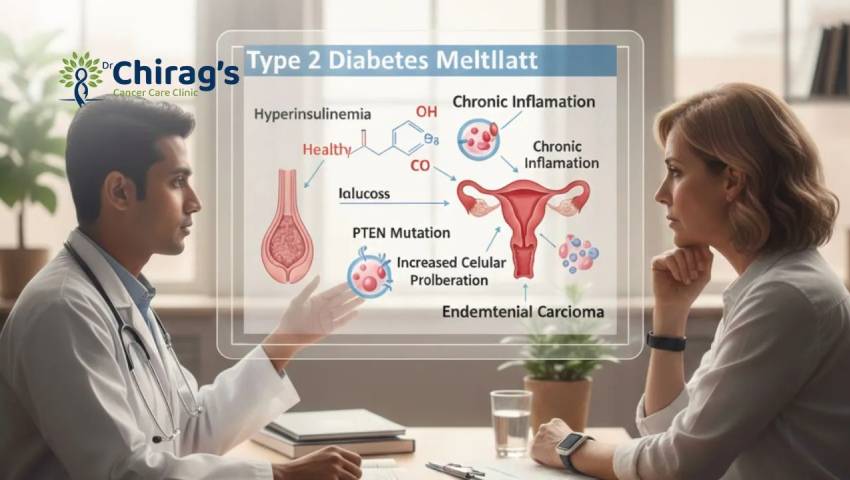
- The Biological Mechanism: The link is driven by Hyperinsulinemia (excess insulin due to insulin resistance) and Hyperglycemia. Insulin acts as a potent growth factor, directly fueling the proliferation of endometrial cancer cells.
- Hormonal Overload: T2DM is often paired with obesity, leading to unopposed estrogen exposure—a major contributor to the most common type of EC (Type 1 Endometrioid Cancer).
- Crucial Warning Sign: Abnormal Uterine Bleeding (AUB) is the most important symptom for diabetic women to report immediately, as early detection is key to survival.
- Integrated Treatment: Managing EC in diabetic patients requires collaboration, with surgery as the cornerstone. Minimally invasive surgery is preferred, and the diabetes drug Metformin is showing promise for its anti-cancer properties.
- Survival Factor: Tight glycemic control is vital for recovery. High blood sugar impedes wound healing, increases infection risk, and is associated with higher rates of cancer recurrence.
How Does Diabetes Fuel Cancer Growth?
To truly grasp the gravity of this connection, we must look beyond just blood sugar levels and examine the complex biological landscape created by diabetes. How does diabetes fuel cancer growth?
The primary mechanism revolves around a concept called Insulin Resistance. In T2DM, the body’s cells don’t respond properly to insulin, forcing the pancreas to produce more, resulting in a state of Hyperinsulinemia (excessive insulin circulating in the bloodstream).
Insulin isn’t just a sugar regulator; it’s a potent growth factor. High levels of insulin, along with related substances like the Insulin-like Growth Factor 1 (IGF-1), directly interact with receptors on the lining of the uterus, known as the endometrium.
This interaction sends strong pro-growth signals to the endometrial cells, encouraging them to divide rapidly, resisting natural cell death (apoptosis), and ultimately accelerating the process of cancerous transformation.
Furthermore, T2DM is often closely tied to obesity, a major independent risk factor. Fat tissue doesn’t just store energy; it acts as an endocrine organ, converting other hormones into estrogen.
This continuous, unchecked estrogen stimulation of the endometrium, often without the balancing effect of progesterone, creates an environment ripe for what we call Type 1 Endometrioid Cancer.
This intricate interplay between hyperglycemia, hyperinsulinemia, and unopposed estrogen is the driving force behind this alarming dual diagnosis.
What Are the Warning Signs and Diagnostic Steps?
Given this heightened risk, proactive awareness is vital. What symptoms should a woman with diabetes look out for, and how is this cancer diagnosed and staged?
The most crucial warning sign is Abnormal Uterine Bleeding (AUB). For postmenopausal women, this means any spotting or bleeding whatsoever.
For premenopausal women, it might manifest as unusually heavy, prolonged, or irregular periods. If you experience these changes, seeking immediate consultation is non-negotiable.
When diagnosing, we often start with a Transvaginal Ultrasound (TVUS) to measure the thickness of the endometrial lining.
If the measurement is concerning, the definitive step is an Endometrial Biopsy, where a small tissue sample is taken from the uterus lining and examined by a pathologist for cancerous or pre-cancerous cells.
Sometimes, a Hysteroscopy—a procedure that allows us to look directly inside the uterus—is performed.
Once cancer is confirmed, we use imaging tests, such as CT or MRI scans, and subsequent surgery to determine the stage, known globally as the FIGO (International Federation of Gynecology and Obstetrics) stage (Stage I being confined to the uterus, up to Stage IV which is spread to distant organs).
This staging is paramount as it dictates the required intensity of subsequent treatment.
What Treatment Options Exist for Diabetic Patients?
Managing Endometrial Cancer in a diabetic patient requires a highly customized and collaborative approach between the oncology and endocrinology teams. What treatment strategies are available for Endometrial Cancer, especially when a patient also has Type 2 Diabetes?
For most women with EC, the cornerstone of care remains Surgery. This typically involves a Total Hysterectomy (removal of the uterus and cervix) and Bilateral Salpingo-Oophorectomy (removal of both fallopian tubes and ovaries).
As a surgical oncologist , I frequently perform these procedures using minimally invasive techniques where appropriate, which facilitates faster recovery, especially important for patients with comorbidities like diabetes who might face slower healing.
Depending on the final surgical pathology (tumor grade, depth of invasion, and staging), the patient may require Adjuvant Therapy, which includes radiation therapy or chemotherapy, designed to minimize the risk of recurrence.
Furthermore, we now recognize the importance of the diabetes medication Metformin. While primarily used to control blood sugar, research suggests it might have direct anti-cancer properties by interfering with the very pathways (like the PI3K-Akt-mTOR pathway) that fuel cancer growth, making it a promising agent to include in long-term management protocols.
This integrated approach is central to delivering effective Endometrial Cancer treatment in Pune, especially for patients managing complex conditions such as Type 2 Diabetes.
Does Blood Sugar Affect Cancer Recovery?
This is perhaps the most significant question for long-term health. How does managing my blood sugar impact my recovery and long-term survival after cancer treatment?
The data is conclusive: achieving and maintaining tight glycemic control is critical. High blood sugar levels during and after treatment are associated with poorer wound healing, increased risk of infection, and, critically, higher rates of cancer recurrence and cancer-specific mortality.
Think of sugar as fuel for cancer cells; minimizing this fuel source through dedicated diabetes management creates an internal environment less hospitable to cancer survival.
This means diligent monitoring, diet modification, regular physical activity, and working closely with your doctor to manage the entire metabolic syndrome, including hypertension and cholesterol, not just the cancer itself.
Dedication to this metabolic management is directly proportional to a patient’s potential for robust recovery.
What Are the Key Preventive and Support Measures?
A dual diagnosis can be overwhelming, necessitating comprehensive and empathetic support. Beyond medical treatment, what emotional support and preventive steps can patients take to live healthier lives?
The intersection of cancer and a chronic condition like T2DM demands an integrated, people-first approach. We must focus on improving your in your own body’s care. Lifestyle changes are perhaps the most powerful tool.
Prioritizing weight management and adhering to a low-glycemic, anti-inflammatory diet can directly combat the hormonal and inflammatory drivers of EC.
Emotional care, often overlooked, is vital; seeking counseling or support groups can significantly ease the emotional burden of dual diagnosis. Regular, personalized medical surveillance is non-negotiable.
By maintaining vigilance over both your cancer history and your diabetes status, we empower you to stay ahead of the curve.
Conclusion:
The link between Type 2 Diabetes Mellitus and Endometrial Cancer is powerful, but it is a challenge we are equipped to handle through proactive screening, specialized surgical intervention, and rigorous, integrated metabolic management.
By addressing the root causes—the hyperinsulinemia and the inflammatory environment—we can dramatically influence both short-term recovery and long-term survival.
Remember, your health journey is a partnership, and taking control of your diabetes is one of the most powerful steps you can take in your fight against cancer.
Connect with Dr. Chirag Bhirud, a leading Onco Surgeon, for expert consultation and advanced treatment options. Schedule your personalized consultation today to ensure you receive integrated, evidence-based care right here in Pune.